![]()
|
|||
|---|---|---|---|
One of our specialities is training or sourcing KNPV dogs. It is therefore appropriate to give a bit of background on what the KNPV is. |
|||
![]() |
The town square in Roosendaal. Far left "The Unicorn" pharmacy where the KNPV was founded. |
||
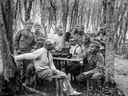
The first trial rules were made in 1908, but many additions and changes were to follow dictated by experience in the potential of the dogs, as well as having to adjust the rules to reality. The fact remained however, that under every set of trial rules the dog, in order to pass, had to be totally controllable at all times. An early group of KNPV trainers with their dogs. |
|||
The pioneers for the KNPV were Mr. Couwenberg with his Boxer ‘Max’, Mr. Van Oosten with his Shepherd ‘Hector’, Mr. Steijns with his Dutch Shepherd ‘Germanicus’ (Frits), and Mr. Lokerse with his French Shepherd ‘Piet’. Even before there was a NPV, these men achieved very good results with their dogs for which they should be honored. Police Commissioner Muller, a judge for the German ‘Polizeihund Verein’, invited Mr. Ch. Herfkens, Police Inspector in The Hague, to come to a competition for police dogs in Hagen, Germany in September of 1907. There, Mr. Herfkens met Mr. M. Kessler, also from The Hague, and together with him and an acquaintance of Kessler, Mr. J. Steijns from Roosendaal, they decided that it was time to found a Police Dog Association in Holland, just like Belgium and Germany had done before them. On October 25, 1907, these three gentlemen came together in the house and pharmacy “The Unicorn” of J. Steijns, Pharmacist in Roosendaal, and founded the (K)NPV. The official day of founding is Friday, November 1, 1907, and that date is found in minutes of the first meeting. |
|||
Of all the people that contributed to the growth of the young KNPV, Mr. J. Key certainly needs mentioning. He was the president between 1920 and 1926 and one of the first sets of trial rules was, for the most part, made by him. The German Police Dog Association is said to have copied large sections of it for their program in those days. Colonel G.J.P.A. Thomson, treasurer from 1920-1927 is also mentioned as one of the main driving forces behind the sometimes-shaky KNPV. Colonel Thomson Mr. Key The heart of the new association was certainly in the region ‘Zuid Holland’. But before too long, without informing the NPV of this, in the Dutch Region of ‘Overijssel’, some NPV members declared themselves a region of the association and thus the structure of the future KNPV, with one national board and regions with separate boards, was formed. |
![]() |
||
Regions: The KNPV dogs In the early days, even before the (K)NPV was founded, various breeds were used for police work. In the first 25 years of existence, a limited amount of dogs received a KNPV title, not quite 33 dogs a year, the low being 1921 with 12 dogs, the high 1925 with 60. Compare that to the current numbers, approximately 1000 certificates of the combined disciplines per year.
"Spits", Dutch Shepherd Bitch, GSD bitch "Kelinerin" callname "Ali" born 6-17-1909 The dogs that were used most in those days were Malinois, Dutch Shepherds, German Shepherds, Dobermans, Groenendaels (called Belgian Sheepdog in the USA) and Bouviers. The list below shows some other breeds as well but they were obviously more of an exception. The fact that the Dutch Shepherd started off as the front runner, when it comes to the breeds that were used, could possibly be caused by the fact that people used dogs that were readily available to them. Due to the breeding policy for the Dutch Shepherds, dictated by the NHC, a lot of good dogs were excluded as Dutch Shepherds (for example in 1914, with no prior warning only brindle dogs could be registered, and up to that point, many colors, including ‘yellow’ had been permitted), but these same dogs could be entered as Belgian Malinois in those days. Maybe that explains part of the sudden increase of Malinois in the KNPV. Statistics show the total for the first 25 years, adding up to 822 dogs that received a KNPV title. The six most prevalent breeds listed above plus 5 Airedale terriers, 8 Briards, 15 Beaucerons, 9 Rottweilers, and 1 Giant Schnauzer were titled. The rest (29) were of mixed breed.
Doberman bitch "Lida" pedigree NPV 286, born 3-15-1911 Rottweiler bitch "Ortrud" (owned by the KNPV) and her pups, born 5-17-1916 One of the founders of the region Utrecht, Mr. D. Otten tells us in 1932 how he regretted that some outstanding Dutch Shepherd lines which were successfully trained for the KNPV and had proven their prodigy were later forgotten when it came to the breeding of KNPV dogs. The breeding of dogs of unknown background started to happen more and more. This was partly to blame on finances only (crosses were cheaper than pedigreed dogs), and partly to blame on the fact that the “Raad van Beheer”, the Dutch pedigree registry (FCI), contrary to surrounding countries, did not require a dog that won a championship in conformation to also have a working title of some kind.
Today Since history is made every day, this is far from being a complete overview of the KNPV. It is limited to the early beginnings of the Association, which is still very much alive, and producing great dogs for Police service applications all over the world. A continuing summing up of names of the people that carried the KNPV through the 20th century could follow. Many very inspired and knowledgeable people gave their best for the benefit of this wonderful organization and continue doing so to this day. We hope that the KNPV has a future ahead of her, as impressive and solid as her past. Long live the KNPV. By Judith van Heugten Powell The above was translated from text by Judith van Heugten Powell. The KNPV today has evolved as a modern dog sporting organization. The standards are recognized as some of the highest in the world. A dog with a KNPV PH1 met lof title is quite a dog indeed. |
|||